Product Overview
Alvin's Cables RJ45 Ethernet Cable, CAT6A Shielded Industrial Profinet Cable High-Flex Drag-Chain High-Speed Gold-Plated Connectors for PLC, Robotics & Motion Control 3.15-4.92ft/96-150cm Green is built for a very specific problem: how to make a short network connection that stays neat, moves with the equipment, and does not leave loose slack to snag on tools, rails, or cabinet hardware. In benches, automation cells, and compact network layouts, a coiled cable can save space while still giving the user enough reach when the equipment shifts or opens.
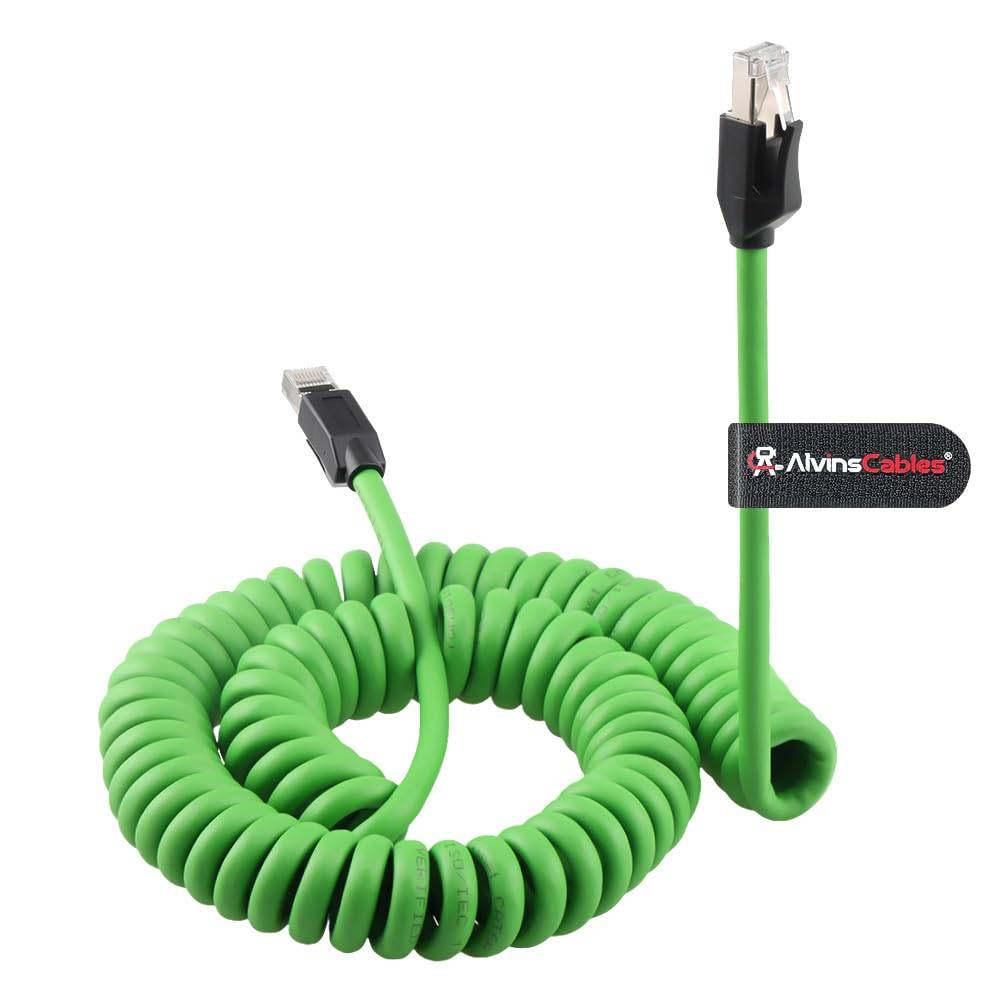
From the visible product photo, the cable is a bright green spiral lead with RJ45-style modular plugs on both ends, each finished with a molded black strain-relief boot. One end is shown extended while the other remains tightly coiled, which makes the cable easy to route in setups where tidy cable management matters more than a permanently straight line.
The exact cable category, shielding structure, conductor material, and performance rating are not visible in the image, so those details should be confirmed against the final specification before purchase if your application depends on them. What can be verified visually is the coiled form factor, the modular plug style, and the flexible geometry intended to retract after extension.
What This Cable Solves in Real Work Environments
Short patch cables often create two kinds of problems. If they are too short, they pull on the connector and limit device placement. If they are too long, they form loops that catch on trays, hinges, moving carriages, and test equipment. A coiled Ethernet cable sits between those extremes. It can remain compact during storage, then stretch when a device needs extra reach, and retract again when the load returns to its resting position.
That makes this style of cable useful for fixed workstations, mobile carts, lab benches, and equipment racks where users repeatedly plug, move, and re-plug networked hardware. It also suits environments where a bright jacket helps the cable stand out against darker panels and machine frames.
Key Specifications and Visible Design Features
Coiled construction
The cable uses a tight spiral body rather than a straight jacket. This design supports extension and recovery, helping reduce clutter when compared with a loose patch lead. Coiled cables are commonly chosen when cable slack must be controlled without using clips, ties, or retractors.
RJ45-style modular connectors
Both ends show clear/black RJ45-style plugs with visible metal contacts at the tip. The latch profile is the standard modular style used across many Ethernet and networked control connections. Because the exact shielding and internal wiring are not visible, buyers should confirm compatibility with their network or industrial interface requirements.
Strain-relief boots
Each connector is finished with a molded black boot, which helps reduce bending stress at the termination point. In practice, this matters as much as the plug itself. Repeated flex at the connector neck is a common failure point on short cables, especially in motion-heavy work areas.
Bright green jacket
The vivid green outer jacket improves visual tracking on benches, inside racks, and around mixed cable harnesses. Color coding can help technicians identify the correct link faster during maintenance, troubleshooting, or changeovers.
Materials and Finish Options
Based on the visible construction, the outer jacket appears to be a flexible plastic or PVC-like material with a glossy to semi-opaque finish. The plug bodies appear to use clear plastic sections with dark internal parts, while the boots are matte black. These are common material choices for patch cables because they balance bendability, grip, and connector protection.
The supplier also describes its broader cable portfolio as using gold-plated contacts and materials selected for demanding environments. For this specific cable, that should be treated as the listing intent unless the final specification sheet confirms it. If your project requires exact connector plating, shielding type, or jacket compound, ask for the detailed build before integrating it into production.
How It Is Typically Manufactured
A cable like this is usually produced through a sequence of extrusion, cutting, coiling, termination, and overmolding. The jacket material is first formed into the required cable body, then the conductors are terminated into RJ45-style plugs, and finally the strain-relief boots are molded or fitted to support the transition between plug and jacket.
The coiled profile is not just a visual style. It requires controlled forming so the cable can extend and return without taking a permanent set too quickly. That is one reason buyers of motion-oriented cables often evaluate recovery behavior, not just connector appearance. If the cable will be used repeatedly in a moving assembly, the coil memory and connector retention deserve attention during qualification.
Alvin's Cables states that its cables go through extensive quality inspection, including 137 quality checks across its production process, and that its gold-plated contacts are designed for long cycle life. Those are company-level claims for the brand's cable program, and they are useful indicators of manufacturing discipline. For a critical industrial installation, still verify the exact specification for the individual cable model you intend to order.
Typical Application Scenarios
This style of short coiled network cable fits best where devices are close together but not fixed at one distance. Common use cases include desktops, patch-panel adjacencies, test fixtures, lab benches, portable engineering stations, and rack-mounted equipment that may need occasional movement during service.
In industrial spaces, the same format can help on control cabinets, temporary diagnostic setups, machine-side service ports, or mobile inspection stations. If the cable is being considered for PLC, robotics, or motion-control work, the important questions are not only length and connector style, but also how the cable will behave under repeated movement, what the mating ports require, and whether the assembly is meant for a protected indoor space or a harsher operating zone.
For cable management, coiled format is useful wherever slack must be present only when needed. That makes it a practical choice for technicians who want a tidy route without sacrificing access.
Quality Control Points Buyers Should Check
Before specifying a cable like this, buyers should confirm the basics that affect fit and service life. Start with connector engagement: the latch should lock firmly and release cleanly. Then check extension behavior, because a coiled lead should stretch smoothly without feeling uneven or overly stiff.
It is also wise to verify pinout continuity, especially if the cable will interface with managed network gear, industrial controllers, or a controlled harness. The outer jacket should recover after normal use, and the strain-relief boots should show no visible separation from the plug body. If the cable is intended for repeated motion, ask for validation of bending behavior under the actual installation pattern rather than assuming a general-purpose patch lead will be sufficient.
Customization Guidance for OEM and B2B Buyers
Alvin's Cables says it offers customized solutions for specialized workflows, including changes to connector types, cable lengths, and functional designs. For a coiled Ethernet cable, customization often starts with the stretch length, the relaxed coil diameter, the plug orientation, and the jacket color. Those choices affect how the cable behaves in a real installation far more than a catalog photo can show.
If you are sourcing for a machine build, specify the target device, the installed distance, the movement range, and the environment around the cable path. Ask whether you need a shielded or unshielded construction, what plug style is required, whether the boots must fit into a tight panel opening, and how visible the cable must remain to operators or service staff.
For motion-heavy use, it is especially important to define the motion profile. A cable that only needs occasional extension is not the same as one that must live inside an actively moving route. Share the expected cycle pattern so the supplier can advise on the right build rather than guessing from a general product name.
Buyer Decision Factors
When comparing a coiled RJ45 cable against a standard straight patch cord, the first question is movement. If your connection point changes often, or if the cable needs to retract to stay out of the way, the coiled format is usually the better fit. If the run is fixed and motion is minimal, a straight cable may be simpler.
Next, check the actual operating distance in both relaxed and extended states. The advertised length range should match your install space, but the cable also needs enough recovery to avoid permanent sag. Consider connector clearance around the port, because some recessed jacks or dense patch fields can be difficult to reach with bulky boots.
Color can matter more than buyers expect. In complex racks or machine spaces, a high-visibility green jacket makes tracing the line faster. For service teams, that can reduce downtime during troubleshooting. Finally, verify the network and environmental requirements. The product title includes terms like CAT6A and shielded industrial use, but the visible sample alone does not confirm those technical details, so the final selection should be made against the exact build sheet.
Request the Right Version for Your Setup
If you need a short, retractable network cable with RJ45-style ends for a compact workstation, test bench, rack, or industrial cabinet, this green coiled design is a practical starting point. For buyers who need precise connector types, specific lengths, or a version adapted to a motion-controlled workflow, Alvin's Cables can help define a custom solution.
Send the required distance, the movement pattern, and the device interface details, and request the exact cable construction before ordering. That is the best way to match the cable to the job instead of relying on a generic patch lead.