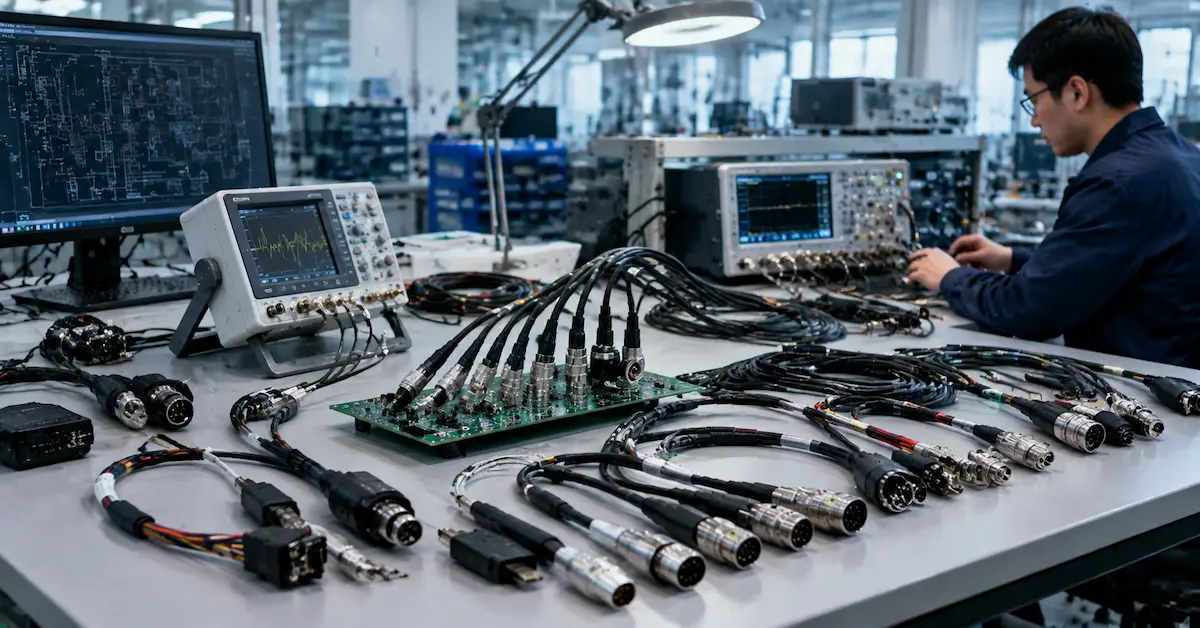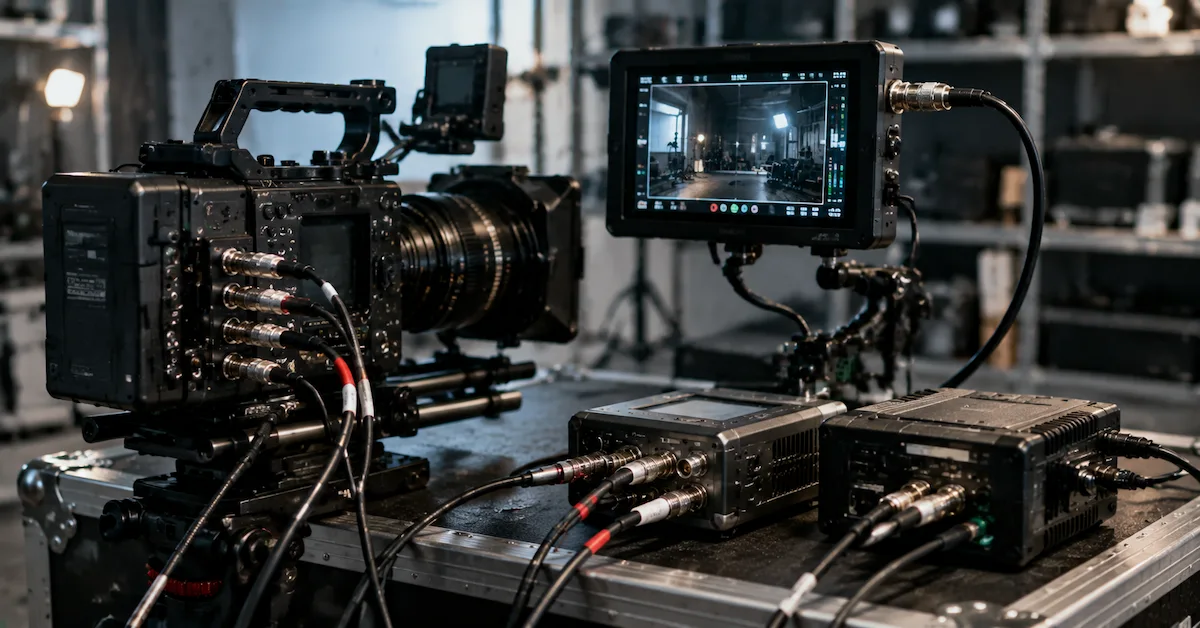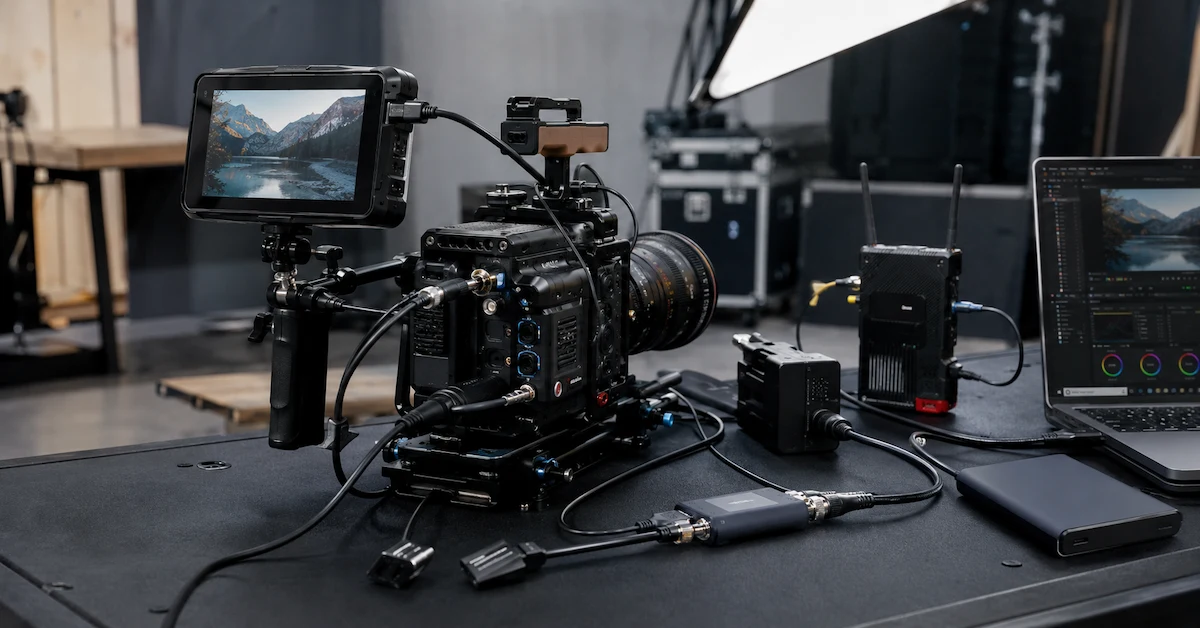
A reliable battery charging cable supplier helps professional buyers create safe and compatible connections between chargers, camera batteries, V-Mount systems, portable power equipment, and professional AV battery packs.
Unlike a standard device power cable, a battery charging cable forms part of the charging system. Its connector type, polarity, pin configuration, voltage rating, current capacity, and compatibility with the charger and battery management system must all be confirmed before use.
An incorrectly specified cable can result in charging failure, unstable current, connector overheating, reversed polarity, battery damage, or equipment downtime. Film production companies, rental houses, camera accessory brands, distributors, and broadcast teams therefore need more than a cable with matching plugs. They need a supplier that understands the complete charging application.
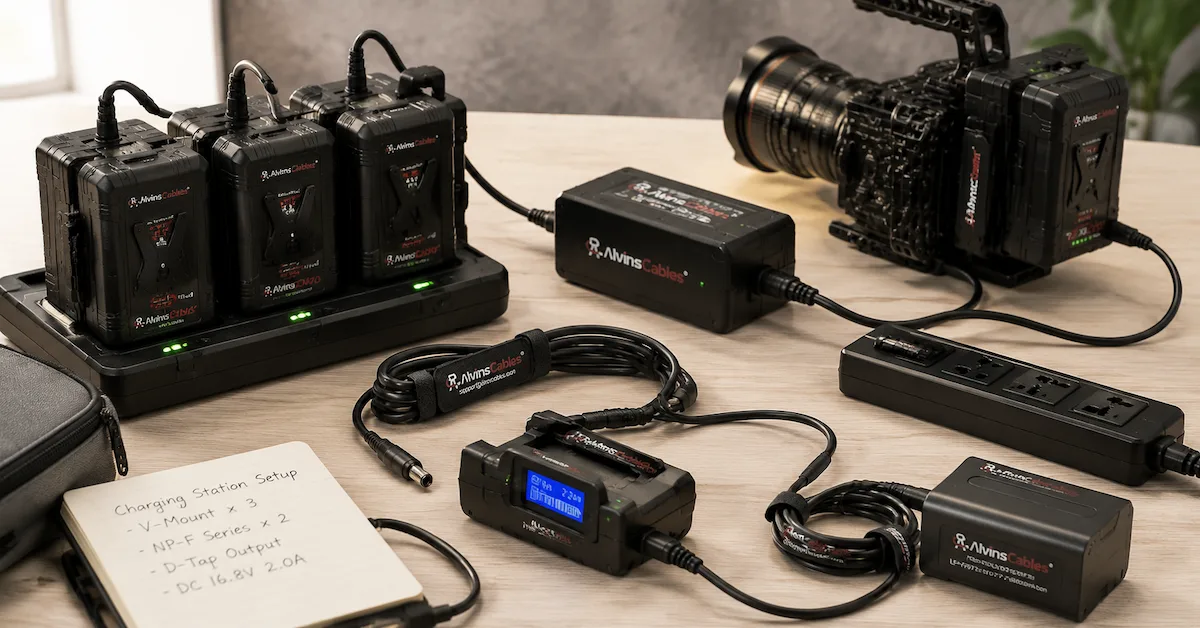
Quick Answer: What Should a Battery Charging Cable Supplier Provide?
A professional battery charging cable supplier should manufacture cable assemblies according to the charger, battery, connector, and electrical requirements of the project.
Key capabilities should include:
- Charger-to-battery cable development
- Custom connector combinations
- Polarity and pinout verification
- Charging voltage and current matching
- Exact cable-length customization
- Straight and right-angle connector options
- Flexible cable construction
- Reinforced strain relief
- Prototype and small-batch support
- Repeat and OEM production
The supplier should request detailed battery and charger information before confirming the cable design.
Battery Charging Cable vs Camera Power Cable
Charging a battery and powering a camera are not the same application.
| Factor | Battery Charging Cable | Camera Power Cable |
|---|---|---|
| Main purpose | Connects a charger to a battery | Connects a battery or power source to equipment |
| Connected equipment | Charger and battery pack | Camera, monitor, recorder or transmitter |
| Electrical control | Depends on charger and battery system | Delivers device operating power |
| Key requirements | Charging voltage, current, polarity and pinout | Device voltage, current and connector compatibility |
| Common risk | Incorrect charging or battery damage | Equipment shutdown or unstable operation |
| Best practice | Use only with an approved charging system | Match the connected device specification |
A cable alone does not control battery charging. The charger and battery management system must provide the correct charging profile and protection for the battery chemistry.
Common Battery Charging Cable Applications
V-Mount Battery Charging
V-Mount batteries are widely used in cinema cameras, monitors, wireless transmitters, recorders, and professional lighting systems.
Charging cables may connect:
- A dedicated charger to a V-Mount battery
- A charging station to a compatible battery port
- A portable charging system to a battery pack
- An OEM charger to a custom battery product
The battery model, charger output, connector type, pin configuration, and approved charging method must be confirmed.
Camera Battery Packs
Professional and compact camera batteries may use dedicated charging ports or battery-specific adapters.
Custom cables can support:
- Camera battery charging stations
- Multi-battery charging systems
- Rental-house charging cases
- OEM camera accessory packages
- Portable production charging kits
Gold-Mount Battery Systems
Gold-Mount batteries are also used in professional production. Buyers should confirm whether the cable connects directly to the battery, a charging plate, or a dedicated charger interface.
Portable Power and Field Charging
Field-production teams may need to recharge batteries away from a fixed studio.
A custom charging cable can help connect compatible:
- Portable power stations
- Vehicle charging systems
- Mobile battery chargers
- Charging cases
- Production power carts
The charging electronics must remain suitable for the battery system. A custom cable should not be used to bypass required charging control.
Rental-House Charging Systems
Rental houses manage batteries from different manufacturers, capacities, and equipment kits. Clearly specified cable assemblies can improve charging-station organization and reduce accidental connector mismatches.
Key Factors When Choosing a Battery Charging Cable Supplier
1. Battery and Charger Compatibility
The first step is confirming the complete charging system.
Buyers should provide:
- Battery manufacturer and model
- Charger manufacturer and model
- Battery chemistry
- Nominal battery voltage
- Maximum charging voltage
- Recommended charging current
- Charger output specification
- Charging-port connector
- Approved charging method
A connector that physically fits does not automatically mean that the charger and battery are electrically compatible.
2. Connector Type and Pin Configuration
Battery charging cables may use:
- D-Tap connectors
- DC barrel connectors
- XLR connectors
- LEMO-style connectors
- Multi-pin circular connectors
- USB-C connectors
- Battery-specific charging connectors
- Custom OEM interfaces
For each connector, confirm:
- Connector manufacturer or standard
- Male or female configuration
- Pin assignment
- Positive and negative terminals
- Communication or sensing pins
- Locking requirements
- Connector orientation
Some charging systems use additional pins for temperature sensing, battery identification, or communication. These pins must not be ignored.
3. Charging Voltage and Current
A custom battery charging cable must safely support the charger’s maximum output.
Important specifications include:
- Maximum voltage
- Continuous charging current
- Peak current
- Cable length
- Connector current rating
- Conductor capacity
- Expected charging duration
A cable with insufficient capacity may generate heat or create excessive voltage drop. Oversized construction, however, may make the cable unnecessarily stiff and difficult to manage.
The cable structure should be matched to the real charging load.
4. Polarity Verification
Incorrect polarity can damage the charger, battery, connector, or internal protection components.
A professional battery charging cable supplier should confirm polarity using:
- Equipment specifications
- Connector diagrams
- Approved samples
- Existing cable references
- Electrical continuity testing
Buyers should never assume that identical-looking connectors use the same polarity.
5. Cable Length and Charging-Station Layout
Cable length affects charging-station organization and electrical performance.
A cable that is too short may:
- Limit battery placement
- Pull on charging ports
- Make charging cases difficult to organize
A cable that is too long may:
- Create clutter
- Increase resistance
- Become tangled with other charging leads
- Make inventory management more difficult
Custom lengths are useful for charging carts, rental cases, studio workstations, mobile charging kits, and OEM packaging.
6. Flexible Jacket and Strain Relief
Charging cables are frequently connected, disconnected, coiled, transported, and stored. The connector-to-cable transition is therefore a common failure point.
Reinforced strain relief helps protect:
- Internal conductors
- Solder joints
- Connector terminals
- Cable insulation
- Battery and charger ports
A flexible jacket also improves handling around charging cases and crowded workstations.
Common Charging Cable Options
| Cable Solution | Typical Application | Main Requirement |
| D-Tap Charging Cable | Compatible professional battery systems | Correct charging method and polarity |
| DC Charging Cable | Battery chargers and compact packs | Connector size, voltage and current |
| XLR Charging Cable | Broadcast and professional battery systems | Pinout and secure locking |
| Multi-Pin Charging Cable | Smart batteries and OEM systems | Power, sensing and communication pins |
| Portable Charging Cable | Field-production charging kits | Flexibility and equipment compatibility |
| Custom OEM Charging Cable | Branded batteries and chargers | Repeatable specifications and packaging |
Who Needs Custom Battery Charging Cables?
| Buyer Type | Main Requirement |
| Film production companies | Reliable charging for camera batteries |
| Broadcast teams | Organized multi-battery charging systems |
| Rental houses | Durable and identifiable charging leads |
| Battery brands | OEM charging cable development |
| Camera accessory brands | Charging cables for bundled products |
| Distributors | Consistent replacement-cable supply |
| AV integrators | Custom charging carts and cases |
| Mobile production teams | Portable field-charging connections |
These buyers need repeatable specifications and compatibility support, not only generic cable inventory.
Questions to Ask Before Choosing a Supplier
A professional buyer should ask:
- Can the supplier review the battery and charger models?
- Can polarity and pinout be verified?
- Can sensing or communication pins be supported?
- Can cable length be customized?
- Can straight and right-angle connectors be supplied?
- Is conductor capacity selected for the charging current?
- Is strain relief reinforced?
- Can a prototype be tested before production?
- Can repeat orders maintain the same specification?
- Can OEM labeling and packaging be supported?
A supplier that asks detailed technical questions is usually reducing project risk rather than complicating the quotation process.
Why Alvin’s Cables Is a Suitable Custom Cable Partner
Alvin’s Cables provides professional cable solutions for photography, film, broadcast, AV, and industrial applications.
For compatible battery charging cable projects, Alvin’s Cables can evaluate requirements involving:
- Custom connector combinations
- D-Tap and DC cable assemblies
- XLR and locking connectors
- Cable-length customization
- Straight and right-angle designs
- Flexible cable structures
- Reinforced strain relief
- Prototype and low-volume development
- Repeat and OEM production
Buyers can review existing cable products through the Alvin’s Cables product center.
For a project-specific charging connection, submit the battery model, charger model, connector information, electrical requirements, quantity, and application through custom cable solutions.
Information Required for an Accurate Quote
| Required Information | Why It Matters |
| Battery model | Identifies voltage, chemistry and charging interface |
| Charger model | Confirms the approved charging output |
| Connector at both ends | Defines the cable assembly |
| Connector pinout | Prevents wiring errors |
| Polarity | Protects the battery and charger |
| Charging voltage | Determines electrical suitability |
| Charging current | Guides conductor and connector selection |
| Required cable length | Supports routing and voltage-drop evaluation |
| Application environment | Guides material and durability choices |
| Estimated quantity | Supports prototype and production planning |
| Packaging requirements | Important for OEM and distribution projects |
Clear technical information reduces revisions and speeds up project evaluation.
Submit these details through the Alvin’s Cables request a quote page.
Procurement Risks to Avoid
Avoid these common sourcing mistakes:
- Ordering by connector appearance alone
- Assuming polarity without verification
- Using a power cable as a charging cable
- Ignoring the approved charger specification
- Failing to confirm battery chemistry
- Omitting sensing or communication pins
- Selecting a cable that is too thin
- Using unnecessary cable length
- Skipping prototype testing
- Purchasing only by unit price
The cost of an incorrectly specified charging cable may include damaged batteries, charger failure, equipment downtime, returns, and after-sales claims.
FAQ
What is a battery charging cable?
A battery charging cable connects a compatible charger or charging system to a battery pack and carries the required charging current.
Can a normal camera power cable charge a battery?
Not necessarily. A device power cable and a charging cable serve different purposes. Charging must use an approved charger and the correct battery connection.
Can battery charging cables be customized?
Yes. Connector type, cable length, polarity, pinout, conductor structure, orientation, and strain relief can be customized.
What information is needed for customization?
Provide the battery model, charger model, connector details, pinout, polarity, charging voltage, charging current, cable length, and quantity.
Can D-Tap be used for battery charging?
Only when the specific battery and charger are designed and approved for charging through that connection. Do not assume every D-Tap port supports charging.
Why are sensing pins important?
Some battery systems use additional pins for temperature sensing, battery identification, communication, or charging control.
Can a prototype be produced before a bulk order?
Prototype testing is recommended for new charger-and-battery combinations, custom pinouts, and OEM charging systems.
Conclusion
Choosing a battery charging cable supplier requires careful verification of the battery, charger, connector, polarity, pinout, charging voltage, current capacity, cable length, and charging method.
A custom cable can improve charging-station organization, equipment compatibility, durability, and repeat-order consistency, but it must remain part of an approved charging system.
Alvin’s Cables can evaluate custom cable requirements for professional camera batteries, charging stations, rental kits, portable production systems, and OEM projects. Submit your battery model, charger model, connector details, electrical requirements, cable length, and quantity through the request a quote page.