A reliable broadcast SDI cable supplier is important for any professional video workflow where stable signal transmission matters. In broadcast studios, live events, cinema production, OB vans, rental kits, and control rooms, SDI cables connect cameras, monitors, recorders, switchers, converters, routers, and video transmission equipment.
For professional buyers, an SDI cable is not just a wire with BNC connectors. It is part of the video signal chain. If the cable fails, the result may be flickering video, black screen, signal loss, unstable monitoring, production delay, or emergency equipment replacement.
That is why film crews, broadcast engineers, rental houses, AV integrators, and equipment distributors need to evaluate cable quality before choosing a supplier. This guide explains what to check when sourcing professional SDI cables and how Alvin’s Cables supports standard and custom cable solutions for demanding video environments.
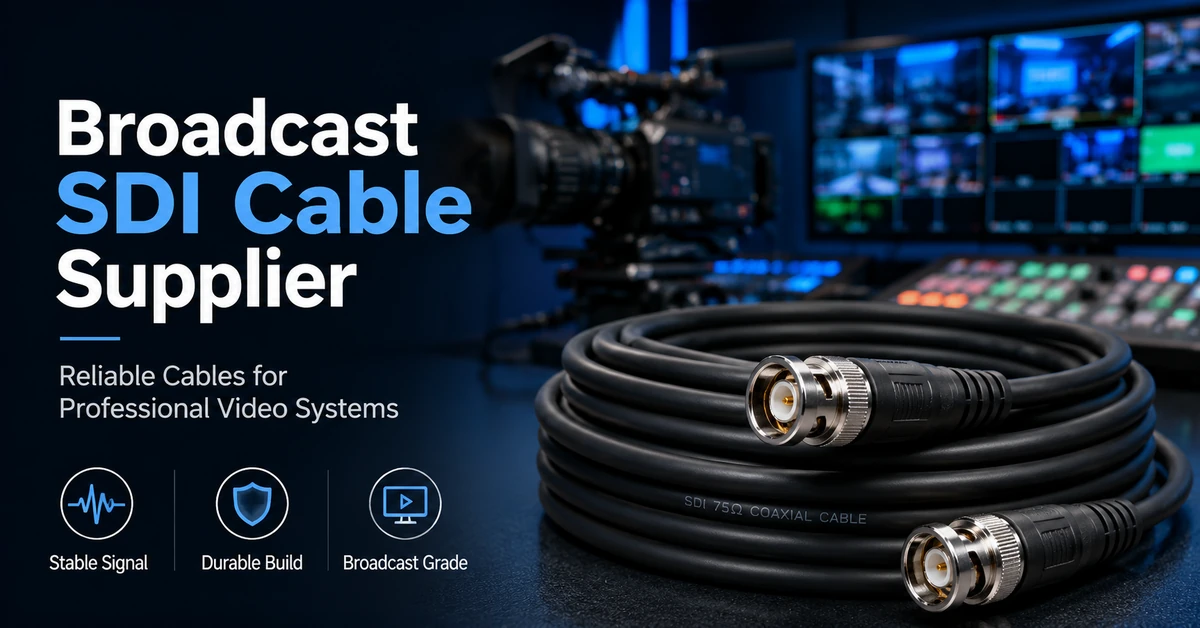
Quick Answer: What Should You Look for in a Broadcast SDI Cable Supplier?
A good broadcast SDI cable supplier should provide stable signal performance, reliable BNC connectors, proper shielding, durable cable jackets, accurate cable length options, strong strain relief, consistent quality control, and support for custom cable requirements.
For B2B buyers, the key points are:
- Stable transmission for HD, 3G-SDI, 6G-SDI, or 12G-SDI workflows
- High-quality BNC connectors with secure locking
- Shielding to reduce interference
- Flexible but durable cable construction
- Custom length support for studio, camera rig, and broadcast setups
- Reliable testing before delivery
- Low-volume prototype and bulk order support
- Technical communication for special video systems
A supplier should not only sell standard cables. It should understand how broadcast video systems are actually used.
Who Needs Professional SDI Cables?
Different customers need SDI cables for different reasons. A broadcast SDI cable supplier should be able to serve multiple professional buyer groups.
| Buyer Type | Main Need | Typical Application |
|---|---|---|
| Broadcast studios | Stable signal for long operating hours | Cameras, switchers, routers, monitors |
| Live production teams | Fast setup and reliable transmission | Concerts, sports, events, conferences |
| Cinema production crews | Camera-to-monitor and recorder connections | On-set monitoring, video village, DIT carts |
| Rental houses | Durable cables for repeated use | Camera kits, monitor kits, broadcast packages |
| AV system integrators | Cable consistency and project compatibility | Control rooms, studios, command centers |
| Equipment distributors | Bulk supply and stable product quality | Resale, accessory bundles, regional markets |
| Industrial video users | Signal reliability in equipment environments | Inspection, machine vision, automation systems |
For these buyers, reliability is often more important than the lowest unit price.
Why SDI Cables Are Still Important in Broadcast Workflows
SDI remains widely used in professional video because it supports stable video transmission with locking BNC connectors. Compared with many consumer-style video connections, SDI is built for production environments where equipment is moved, connected, disconnected, and operated for long periods.
In live production, a cable may run from a camera to a switcher, from a converter to a monitor, or from a router to a recording device. If the connection is unstable, the whole signal chain can be affected.
Common SDI cable problems include:
- Intermittent signal loss
- Poor connector contact
- Weak shielding in high-interference environments
- Excessive cable length without proper signal planning
- Stiff cable that pulls on camera or monitor ports
- Damaged BNC locking mechanism
- Poor strain relief near the connector
- Inconsistent quality between batches
This is why professional buyers should choose a supplier with experience in camera, broadcast, monitor, and custom cable applications.
Key Technical Factors When Choosing SDI Cables
1. Signal Standard and Bandwidth
Before ordering SDI cables, buyers should confirm the required video standard. Different workflows may require HD-SDI, 3G-SDI, 6G-SDI, or 12G-SDI depending on resolution, frame rate, and production equipment.
A cable used for basic HD monitoring may not be enough for high-bandwidth 4K workflows. If the cable cannot support the required signal performance, the system may show unstable video or no signal.
When discussing requirements with a broadcast SDI cable supplier, provide the equipment models, signal standard, target resolution, and cable length.
2. BNC Connector Quality
The BNC connector is one of the most important parts of an SDI cable. A good connector should lock securely, maintain stable contact, and withstand repeated use.
Professional users should check:
- Connector fit and locking feel
- Metal shell quality
- Contact stability
- Soldering or termination consistency
- Strain relief around the connector
- Durability for frequent plugging and unplugging
Rental houses and live production teams should pay special attention to connector durability because cables are used by many operators in different environments.
3. Shielding and Interference Resistance
Broadcast environments often contain power cables, wireless transmitters, LED walls, lighting systems, audio equipment, routers, monitors, and multiple electronic devices. Poor shielding may cause signal instability, especially in complex installations.
A professional SDI cable should have suitable shielding to protect signal quality. For studio systems, OB vans, industrial environments, and long cable runs, shielding is not optional. It directly affects reliability.
4. Cable Length and Signal Planning
Cable length affects both convenience and performance. A short SDI cable is useful for camera rigs and monitor setups. A longer cable may be needed for studio routing or live production, but long-distance signal transmission requires better planning.
Buyers should avoid ordering random cable lengths without considering the setup. A cable that is too long creates clutter. A cable that is too short pulls on ports and increases damage risk.
A custom SDI cable can help match the exact installation or camera rig layout.
5. Flexibility and Jacket Material
Not every SDI cable is used the same way. A fixed studio cable may stay in place for months. A camera cable may bend around a rig every day. A rental cable may be packed and unpacked many times.
Flexible cable material is useful for:
- Handheld camera rigs
- Monitor connections
- DIT carts
- Video village setups
- Rental kits
- Mobile production systems
The cable should be flexible enough to route cleanly but strong enough to handle repeated bending.
6. Strain Relief
Many cable failures happen near the connector. When the cable is bent, pulled, or twisted, the stress concentrates at the connector end. Good strain relief helps reduce this risk.
For broadcast SDI cable buyers, strain relief is especially important in field production, rental, and mobile setups.
Standard SDI Cable vs Custom SDI Cable
| Option | Best For | Advantages | Limitations |
| Standard SDI Cable | General studio and monitor use | Fast selection, stable SKU, lower complexity | May not fit special rig layouts |
| Short SDI Cable | Camera rigs, monitor mounts, compact setups | Clean routing, less cable clutter | Must match exact device position |
| Long SDI Cable | Studio routing, event production, control rooms | Flexible installation distance | Requires better signal planning |
| Flexible SDI Cable | Handheld rigs and mobile production | Easier cable management | Must still maintain signal quality |
| Custom SDI Cable | OEM kits, rental packages, special systems | Exact length, connector style, application fit | Requires clear technical requirements |
A professional broadcast SDI cable supplier should help buyers choose between standard and custom options based on real application needs.
How Alvin’s Cables Supports Broadcast SDI Cable Buyers
Alvin’s Cables focuses on professional cable and connector solutions for film, broadcast, photography, and industrial applications. For SDI cable buyers, the company can support both product selection and custom requirements.
Buyers can explore standard cable products through the Alvin’s Cables product center:
https://www.alvins.com/custom-category/all
For special length, connector direction, cable routing, shielding, or equipment compatibility requirements, buyers can review the custom cable solutions page:
https://www.alvins.com/custom-cable-solutions
Alvin’s Cables is suitable for buyers who need:
- SDI cables for camera and monitor systems
- BNC video cables for broadcast equipment
- Custom cable length for clean installation
- Flexible cables for camera rigs
- Durable cables for rental use
- Cable solutions for professional AV systems
- Small-batch development before larger orders
- Technical support for special equipment setups
What Information Should Buyers Provide?
To get an accurate quotation from a broadcast SDI cable supplier, buyers should prepare clear technical information.
| Information Needed | Why It Matters |
| Equipment model | Confirms connector and compatibility |
| Signal type | Helps match cable performance |
| Cable length | Affects routing and signal planning |
| Quantity | Helps estimate pricing and production plan |
| Application environment | Studio, field, rental, OB van, industrial |
| Flexibility requirement | Determines jacket and cable structure |
| Connector requirement | BNC type, angle, locking needs |
| Packaging need | Useful for distributors and OEM buyers |
Buyers can submit details through the request form:
https://www.alvins.com/request-a-quote
Common Application Scenarios
Broadcast Studio Systems
Studio systems require stable SDI cables for cameras, switchers, routers, monitors, and control room equipment. Cables may be fixed or semi-fixed, so signal consistency and connector quality are important.
Live Event Production
Live production teams need cables that can be installed quickly and work reliably under pressure. Cable failure during a live event can interrupt the workflow immediately.
Cinema Camera Monitoring
Cinema crews often use SDI cables between cameras, monitors, recorders, wireless transmitters, and video village systems. Short, flexible, and durable cables are preferred for clean rigging.
Rental Houses
Rental houses need SDI cables that can survive frequent use. A cable may be used by different crews, packed into different kits, and exposed to rough handling. Consistency and durability are key.
OB Vans and Mobile Production
Mobile production requires compact, reliable cable routing in limited spaces. SDI cables must be organized, durable, and easy to identify.
Industrial Video and Machine Vision
Some industrial video systems also require stable signal transmission. Shielding, connector strength, and long-term reliability are important in automation and inspection environments.
How to Evaluate Supplier Quality
Before choosing a broadcast SDI cable supplier, buyers should check more than product photos. The supplier should understand professional use and provide consistent quality.
Use this checklist:
- Does the supplier understand broadcast and camera workflows?
- Can they provide standard and custom SDI cables?
- Can they support custom length requests?
- Do they understand shielding and signal stability?
- Is connector quality consistent?
- Can they support small trial orders?
- Can they support bulk or distributor orders?
- Do they provide clear communication before production?
- Can they help reduce cable routing problems?
- Do they offer technical support after delivery?
A supplier with professional AV experience can help buyers avoid wrong cable selection, unstable signal, and repeated replacement costs.
Cost Considerations: Price vs Reliability
For B2B buyers, the cheapest SDI cable is not always the best option. A low-cost cable may work in a simple test but fail in repeated production use.
The hidden cost of a poor cable may include:
- Production delay
- Signal troubleshooting
- Replacement orders
- Damaged reputation for rental houses
- Extra support cost for distributors
- Live event failure risk
- Industrial downtime
- Repeated customer complaints
A reliable broadcast SDI cable supplier helps reduce these risks through better materials, better connectors, proper shielding, and consistent inspection.
Internal Links for Buyers
To understand Alvin’s Cables’ background, visit:
https://www.alvins.com/about-us
To browse available cable products, visit:
https://www.alvins.com/custom-category/all
For custom SDI cable, BNC cable, or professional AV cable solutions, visit:
https://www.alvins.com/custom-cable-solutions
To submit project details and request pricing, visit:
https://www.alvins.com/request-a-quote
For custom order, lead time, shipping, and support questions, visit:
https://www.alvins.com/faqs
FAQ
1. What does a broadcast SDI cable supplier provide?
A broadcast SDI cable supplier provides SDI and BNC video cables for cameras, monitors, switchers, routers, recorders, live production systems, and professional AV workflows.
2. What is the difference between SDI cable and HDMI cable?
SDI cables are commonly used in professional broadcast and cinema environments because BNC connectors can lock securely. HDMI is common for compact cameras and displays, but it is usually more consumer-oriented.
3. Can SDI cables be customized?
Yes. SDI cables can be customized by length, connector type, flexibility, shielding, jacket material, and application requirement.
4. Why is shielding important for SDI cables?
Shielding helps protect the video signal from electromagnetic interference, especially in studios, live events, OB vans, and industrial environments.
5. What cable length should I choose?
The best length depends on your setup. Short cables are suitable for camera rigs and monitors, while longer cables are used for studio routing and live production. Avoid unnecessary extra length because it increases clutter.
6. Are SDI cables suitable for 4K video workflows?
Yes, if the cable is designed for the required SDI standard and signal bandwidth. Buyers should confirm whether the workflow uses HD-SDI, 3G-SDI, 6G-SDI, or 12G-SDI.
7. What information should I send for a custom SDI cable quote?
Send the equipment model, cable length, connector type, signal standard, quantity, application environment, and any special routing or flexibility requirements.
8. Can rental houses order bulk SDI cables?
Yes. Rental houses often need durable SDI cables in multiple lengths for camera kits, monitor kits, and broadcast packages.
9. Can Alvin’s Cables support low-volume custom projects?
Yes. Alvin’s Cables can support custom cable requirements for professional users, equipment brands, rental houses, and special AV projects.
10. How do I contact Alvin’s Cables for SDI cable sourcing?
You can submit your project details through the request a quote page and include your equipment model, cable length, quantity, and technical requirements.
Conclusion
Choosing the right broadcast SDI cable supplier helps professional buyers reduce signal risk, improve cable management, and support stable video workflows. For broadcast studios, live production teams, cinema crews, rental houses, AV integrators, and industrial video users, cable quality directly affects system reliability.
A good SDI cable should offer stable signal transmission, strong BNC connector quality, proper shielding, flexible routing, and durable strain relief. For special production setups, custom SDI cables can provide better fit and lower long-term failure risk.
Alvin’s Cables provides professional cable solutions for video, camera, broadcast, and industrial applications. If you need standard SDI cables, custom BNC video cables, or professional cable support for your project, contact Alvin’s Cables to discuss your requirements.