How to Choose the Right Industrial Ethernet Cable for Your Application
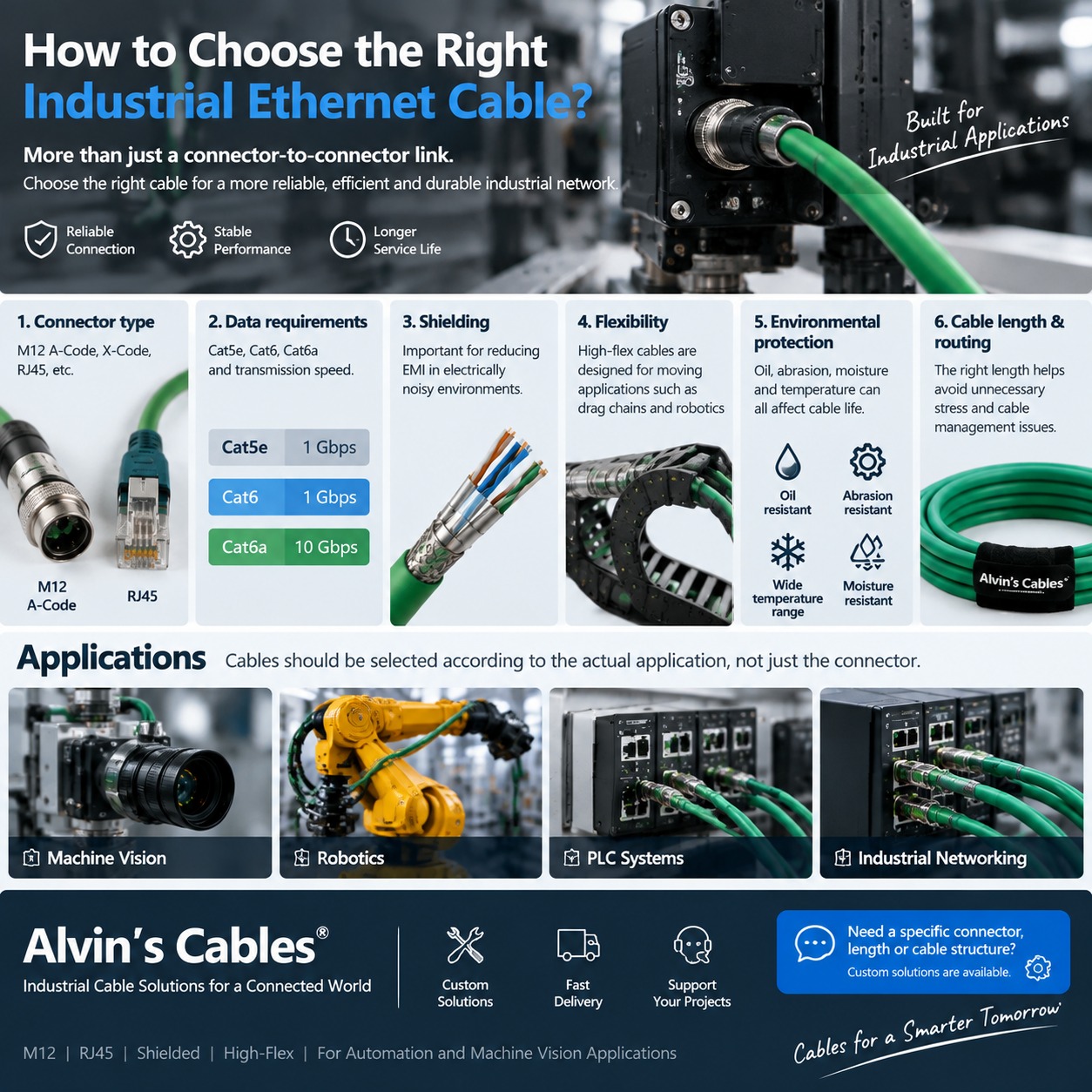
Industrial Ethernet networks are used in increasingly demanding environments. PLCs, industrial cameras, sensors, robotic systems and network devices may need to maintain stable communication while exposed to vibration, repeated movement, electrical interference, oil or abrasion.
Choosing the right Ethernet cable therefore involves more than simply matching two connectors.
1. Start With the Connector
The connector must match both the device and the application.
Common industrial Ethernet configurations include:
- M12 connectors
- RJ45 connectors
- M12 X-Code connectors
- M12 A-Code connectors
- Male-to-male or male-to-female configurations
- Straight or right-angle connector designs
For example, M12 X-Code 8-pin cables are commonly used for industrial Ethernet and machine vision applications, while M12 A-Code configurations can be used for a wider range of industrial automation, sensor and I/O applications.
2. Consider the Data Requirements
The cable construction should match the communication requirements of the system.
For higher-speed industrial Ethernet applications, shielded Cat6a cable can be an appropriate choice when the equipment and network architecture require it.
The key is to check the complete system rather than selecting a cable based only on the connector appearance.
3. Shielding Matters in Industrial Environments
Industrial equipment can operate close to motors, drives, power supplies and other sources of electromagnetic interference.
A shielded cable can help reduce the impact of external interference on signal transmission.
This is particularly relevant for applications such as:
- Machine vision
- Industrial cameras
- PLC communication
- Factory automation
- Robotics
- Industrial Ethernet networks
Alvin's Cables offers shielded industrial Ethernet configurations for applications involving industrial cameras, automation equipment and network devices.
4. Static Installation or Continuous Movement?
This is one of the most important questions when selecting an industrial cable.
A cable installed permanently inside a control cabinet has very different mechanical requirements from a cable moving repeatedly inside a drag chain.
For robotic arms, cable carriers and other dynamic applications, a high-flex cable is designed to better handle repeated bending and movement.
Alvin's industrial cable range includes high-flex configurations intended for drag-chain and dynamic applications.
5. Don't Ignore the Working Environment
Industrial cables may encounter:
- Oil
- Abrasion
- Vibration
- Moisture
- Chemicals
- Temperature changes
- Continuous mechanical movement
Connector protection and cable-jacket construction should therefore be considered together.
For example, some Alvin's Cables M12 I/O products are designed with features including threaded locking, anti-vibration construction and environmental protection for industrial applications.
6. Cable Length and Routing Also Matter
A cable that is too short can create unnecessary tension at the connector.
A cable that is excessively long may create additional routing and cable-management problems.
For industrial installations, the ideal cable length should be based on the actual equipment layout and movement range.
Alvin's industrial cable series provides multiple standard length options, while custom cable configurations can also be considered for specific installation requirements.
What Should You Check Before Ordering?
Before selecting an industrial Ethernet cable, confirm:
|
Requirement |
What to Check |
|
Connector |
M12 / RJ45 / Other |
|
Coding |
A-Code / X-Code / Other |
|
Pin Count |
Correct pin configuration |
|
Network |
Ethernet / PROFINET / EtherNet/IP / Other |
|
Cable |
Cat5e / Cat6 / Cat6a |
|
Shielding |
Shielded or unshielded |
|
Movement |
Static or high-flex |
|
Environment |
Oil / moisture / abrasion / temperature |
|
Length |
Required cable length |
|
Connector Angle |
Straight / right angle |
The right industrial cable is not simply the one that fits the port.
It is the one that matches the connector, signal requirements, mechanical movement and working environment of the complete system.
Alvin's Cables provides industrial cable solutions for automation, machine vision, robotics and industrial networking, with standard and custom configurations available.